
Textile fibers
What is a fiber?
The Duden dictionary describes a fiber as a.. “fine, thin, thread-like structure consisting of a plant or animal raw material (fibrous material) or produced synthetically”. The fibers are the basic material for yarns, nonwovens or fiber composites.
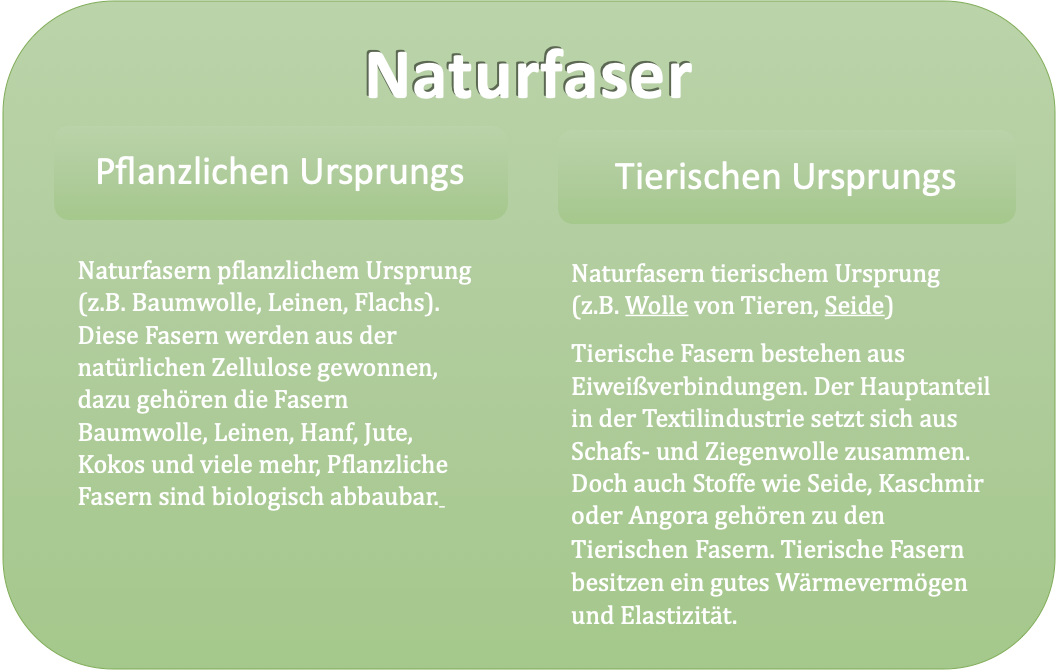
Textile fibers can be roughly divided into two groups: Natural fibers (naturally occurring biogenic and mineral fibers) and man-made fibers (artificially created organic or inorganic fibers). The former can be further subdivided into
Most frequently occurring natural fibers in textiles
Frequently used natural fibers:
| Fiber names | Abbreviations | Fiber group | Origin |
|---|---|---|---|
| Cotton | CO | Natural fiber | Of vegetable origin |
| Gorse | GI | Natural fiber | Of vegetable origin |
| Hemp | HA | Natural fiber | Of vegetable origin |
| Jute | JU | Natural fiber | Of vegetable origin |
| Kapok | KP | Natural fiber | Of vegetable origin |
| Linen / Flax | LI | Natural fiber | Of vegetable origin |
| Silk | SE | Natural fiber | Of vegetable origin |
| Sisal | SI | Natural fiber | Of vegetable origin |
| Animal hair | different, depending on the hair | Natural fiber | Of animal origin |
| Wool | WO | Natural fiber | Of vegetable origin |
Fabrics made from natural fibers tend to shrink the first time they are washed. For this reason, many manufacturers nowadays have started to pre-wash the fabrics before processing in order to be able to neglect the so-called shrinkage factor when cutting and to avoid creating a shrinking effect for the customer when washing.
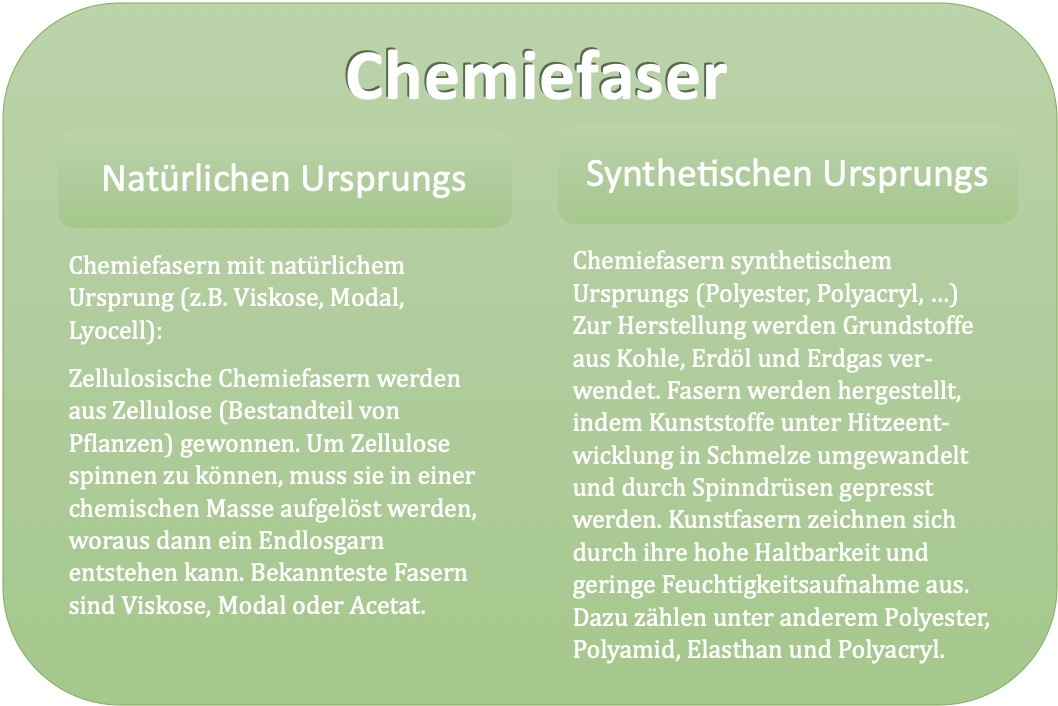
Frequently used man-made fiber:
| Fiber names | Abbreviations | Fiber group | Origin |
|---|---|---|---|
| acetate | CA | Man-made fiber | Synthetic origin |
| Alginate | ALG | Man-made fiber | Synthetic origin |
| Aramid | AR | Man-made fiber | Synthetic origin |
| Cupro | CUP | Man-made fiber | Of vegetable origin |
| Spandex | EL | Man-made fiber | Synthetic origin |
| Elastodiene | ED | Man-made fiber | Synthetic origin |
| Elastolefin | ELO | Man-made fiber | Synthetic origin |
| Elastomultiester | EME | Man-made fiber | Synthetic origin |
| Fluorine fiber | FL | Man-made fiber | Synthetic origin |
| Glass fiber | GF | Man-made fiber | Synthetic origin |
| Lyocell | CLY | Man-made fiber | Of vegetable origin |
| Melamine | MF | Man-made fiber | Synthetic origin |
| Modacrylic | MAC | Man-made fiber | Synthetic origin |
| Modal | CMD | Man-made fiber | Of vegetable origin |
| Polyethylene | PE | Man-made fiber | Synthetic origin |
| Polyamide (nylon) | PA | Man-made fiber | Synthetic origin |
| polyester | PES | Man-made fiber | Synthetic origin |
| Polypropylene | PP | Man-made fiber | Synthetic origin |
| Polyurethane | PU | Man-made fiber | Synthetic origin |
| Reg. protein fiber | Man-made fiber | Synthetic origin | |
| Silk | SI | Man-made fiber | Synthetic origin (>85% acrylonitrile) |
| Trie acetate | CTA | Man-made fiber | Synthetic origin |
| Trivinyl | TV | Man-made fiber | Synthetic origin |
| Viscose | CV | Man-made fiber | Of vegetable origin |
Fabrics made from natural fibers tend to shrink the first time they are washed. For this reason, many manufacturers nowadays have started to pre-wash the fabrics before processing in order to be able to neglect the so-called shrinkage factor when cutting and to avoid creating a shrinking effect for the customer when washing.
Natural or man-made fibers? Which is the better choice?
There is no general answer to this question. Both types of fiber have their advantages and disadvantages, because both types of fiber have different properties. You can choose according to the area of application or the desired properties, and in some cases, fiber blends often provide the required properties.
A detailed list of the fibers, the fiber abbreviations and their properties will soon be available here as a PDF document